— Historical Reflections While Wandering Penang and the Malaysia–Thailand Border, Inspired by the Film Dear You (给阿嬷的情书)
Table of Contents
1. Prologue: Tears in the Darkness of an Unfamiliar Cinema
On June 30, 2026, marking the first month of retirement after three continuous decades in corporate life, I arrived in Malaysia—my wife’s homeland and the warm sanctuary of my in-laws—to embark on a contemplative month-long stay in Penang. Stepping away from the hectic daily rhythm of driving through rushed morning commutes across Seoul, I longed to become a free-spirited stroller, a Flâneur, quietly reflecting upon the yesterday and today of human life in the unfamiliar tropical breeze.
On our second day, before we had even fully unpacked, my sister-in-law and wife suggested catching a widely talked-about local film and brought me to Queensbay Mall in Penang. Stepping into the cinema lobby to seek refuge from the tropical heat, my eyes were immediately captured by a striking movie poster drenched in deep crimson. The title read: 给阿嬷的情书 (English title: Dear You). Drawn by the tender simplicity of the phrase—”A Love Letter to Grandmother”—I stepped into the darkened theater as if guided by an unseen hand.

As the film unfolded across the screen, the dialogue was delivered not in standard Mandarin, but in Teochew (潮汕方言)—a regional southern dialect deeply rooted in Guangdong Province and early Chinese diaspora communities throughout Southeast Asia. Even the accompanying subtitles flickered past in unfamiliar scripts, leaving me standing before an evident language barrier. Yet strangely, despite not comprehending a single spoken line verbatim, an overwhelming ache weighed heavily upon my chest, growing deeper with every scene.
The coarse, calloused hands of the characters on that vintage palette, the silent tears welling in weathered wrinkles around tired eyes, the desperate cries piercing through roaring flames, and the tactile presence of aged, yellowing envelopes crossing decades of separation—all of it communicated the profound weight of human devotion with undeniable clarity.
2. Flames of Nanyang and a Twenty-Year Secret: The Full Depth of Truth
Emerging from the theater into the daylight, I initially assumed the film was merely a poignant romance about two people dedicating their lives to one another after surviving a devastating blaze. A few days later, however, after exploring the complete narrative through contextual summaries, the full truth was unveiled—a tragedy of migration far grander, more heartbreaking, and infinitely more selfless than my initial impression had grasped.
The protagonist, Zheng Musheng (鄭木生), fled the ravages of the Chinese Civil War in the late 1940s, leaving behind his young wife Ye Shurou (葉淑柔) and their infant children in their native Chaoshan to board a clandestine cargo vessel bound for Nanyang (Southeast Asia). His earliest struggles took root right here in Malaysia.
Subjected to brutal physical toil digging in tin mines and laying railway tracks, he remitted almost every hard-earned cent back to his family in China, leaving himself unable even to scrape together the return passage home. Later driven out after protesting unjust labor practices, he crossed into Siam (Thailand), laboring relentlessly through Bangkok’s Chinatown as a pedicab driver, pedaling away his days in sheer physical endurance.
During those grueling years far from home, a catastrophic fire engulfed the dilapidated inn where he lodged. Musheng charged directly into the inferno, heroically rescuing the innkeeper’s daughter, Xie Nanzhi (謝南芝), and her father. That heroic deed, however, left him gravely injured and unfairly imprisoned. Deeply moved by the man who had preserved her family’s lives—and humbled by his unwavering devotion as he worried solely from his prison cell about sending family remittances (Qiaopi, 僑批) to his wife—Nanzhi developed a profound, reverent compassion for him.
Following his release from prison, Musheng eventually found work operating cargo boats. As his financial fortunes turned, he rejoiced like a wide-eyed child: “Just two more years of labor, and I can finally return home to my beloved wife.” Yet cruel destiny had no patience for his modest dream. Confronting armed maritime pirates during a voyage in 1960, Musheng lost his life on the icy expanse of the sea. Without ever setting foot on his native soil again, he perished in his early thirties on foreign waters.
Yet the heartbreak did not end there. Paralyzed by Musheng’s untimely death, Nanzhi recognized a devastating reality: if Shurou, waiting faithfully across the sea, learned of her husband’s demise, the despair might break her will to live altogether.
In that crucible of sorrow, Nanzhi made an almost unimaginable choice. She began imitating Musheng’s handwriting, meticulously drafting letters and remitting money she earned through grueling kitchen labor and street trading under Musheng’s name back to his distant hometown.
“When the moon rises above the ocean expanse, I feel as though I am standing in our homeland. With you held tightly in my heart, ten thousand miles feel like no distance at all.”
Weaving the poetic lines Musheng had once spoken aloud into each correspondence, Nanzhi became Musheng for nearly two decades, quietly sustaining Shurou and her children across the sea. She gave up her own youth and personal future to preserve the fragile hope and hearth of a woman she had never met.
Decades later, following China’s reform era and after clearing years of misunderstandings born of severed communication, the two women—now frail octogenarians crowned with silver hair—sat together bedside, clasping each other’s trembling hands. In that transcendent moment, their bond surpassed ordinary romance, reaching the highest fulfillment of human devotion: one soul shielding and sustaining the life of another across time and distance.
3. Yesterday’s Tears and Today’s Peace Carved into Penang’s Five-Foot Way

Stepping out of the cinema into Bayan Lepas and the historic quarter of Bukit Mertajam (BM), the surrounding urban fabric ceased to feel like a mere weathered, exotic tourist destination. Tracing back to nineteenth-century British colonial building codes designed to shield pedestrians from torrential tropical downpours and blinding equatorial sunlight, these continuous covered walkways are known throughout Southeast Asia as the Five-Foot Way (五腳基 / Kaki Lima).
Walking slowly beneath the continuous arches and cool corridor shadows, I felt the historical weight carried by every worn, weathered floor tile beneath my feet.
By day, itinerant street hawkers unrolled bundles to trade their wares here; by night, impoverished migrant laborers laid woven straw mats upon the cool stone, looking out into the unfamiliar night sky while weeping for distant homelands. This was the very path where Musheng might have walked covered in railway dust, and the very ground where Nanzhi carried heavy loads to sustain two families across borders.
Faded Chinese signboards and ubiquitous brass emblems reading PAJAK GADAI (Pawnshop) stood along the walls—silent relics of the desperate survival struggles endured by generations of early immigrants.
And upon the white pillars of those aged shophouses, exposed to decades of tropical weathering, four red characters remained steadfast: Tian Guan Ci Fu (天官賜福 — “Heavenly Officials Bestow Blessings”), quietly watched over by modest incense holders mounted below.
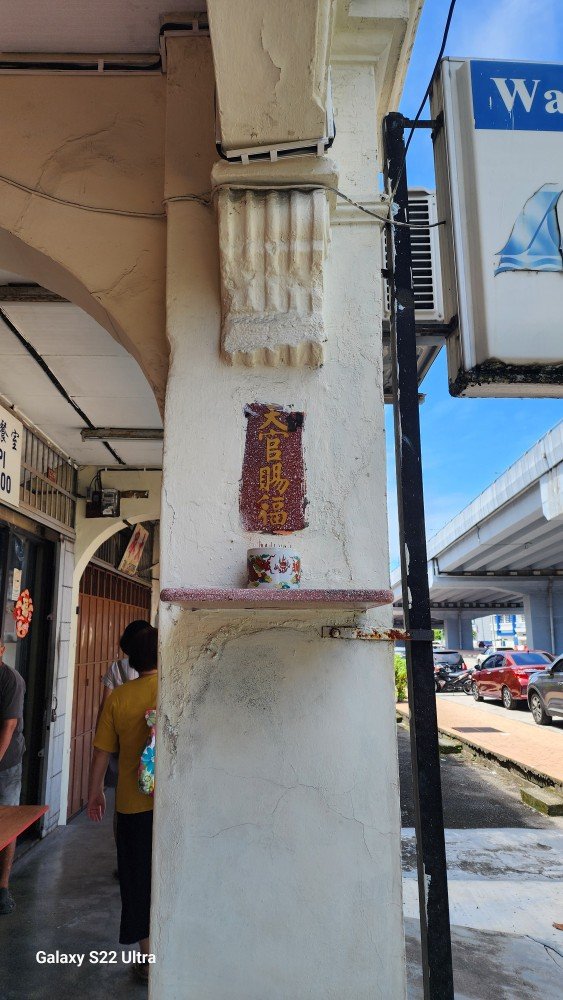
When souls found themselves cast ashore upon the harsh frontier of Nanyang with all worldly ties severed across the ocean, and when pestilence, fire, and suffocating isolation struck their daily lives, the only anchor they had was this reverent prayer for heaven’s blessing. In the single stick of incense lit at the start of each morning, and in the brief prayers whispered with clasped hands before that pillar asking for the safety of distant families, they drew the inner fortitude to endure one more day.
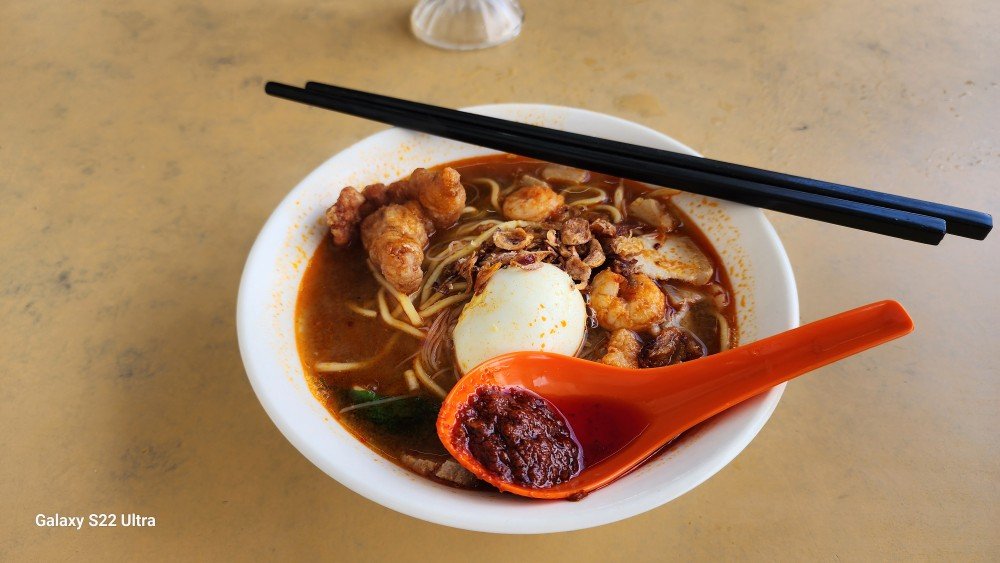
Because that relentless struggle of yesterday and those selfless sacrifices provided rich, fertile soil, today’s peace can blossom so effortlessly. Now, residents gather serenely around Pek Kong Cheng in Bukit Mertajam, sharing steaming bowls of Wanton Mee and Hokkien Mee amid casual laughter.
4. Through the Gaze of a Flâneur: The Blessings and Gratitude of a Traveler
During our month in Penang, we journeyed beyond Bukit Mertajam for a four-day excursion across the border to Samila Beach in Songkhla, Southern Thailand. Standing before the iconic Golden Mermaid statue resting upon coastal rocks and gazing out at the vast Gulf of Thailand merging into the South China Sea, the faces of Musheng, Nanzhi, and Grandmother Ye returned to my mind once more.
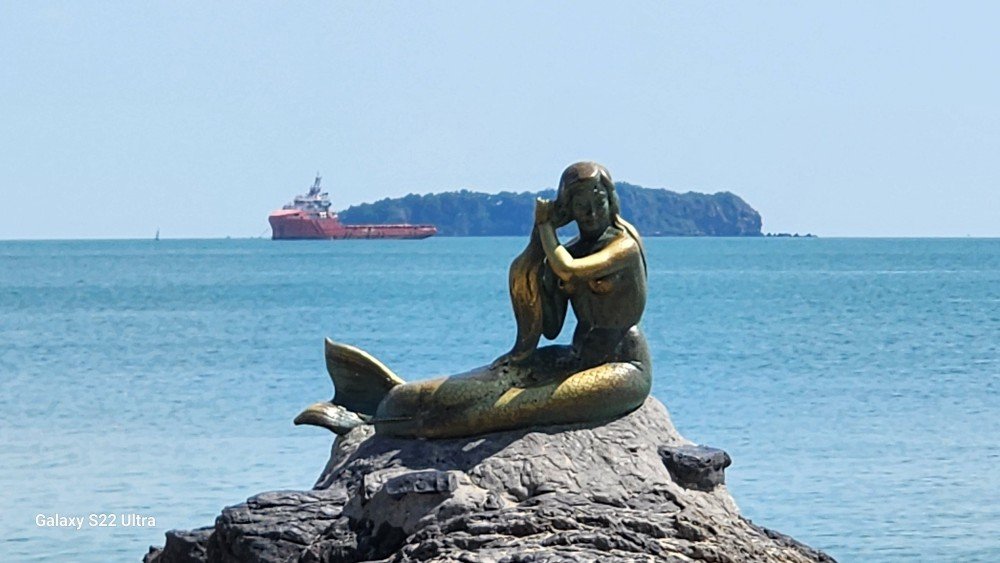
Musheng never managed to cross back over the ocean he yearned for, resting his weary bones forever in the distant soil of Thailand. Grandmother Ye spent the entirety of her youth holding close to her heart the fictional letters of an absent husband. And Nanzhi spent her prime carrying the burdens of two families, never truly experiencing an unburdened life of her own.
What they longed for so desperately yet were never granted was simple: a peaceful, ordinary life alongside the family they loved.
Standing beneath the very same sky and walking these same shores today, how abundantly blessed am I? Though I, too, have left behind thirty years of work and my familiar home to come abroad, I am no isolated wanderer; I walk holding the hand of my beloved wife, cradled within the warmth and tender shelter of my in-laws.
Atop this peaceful earth, nourished by the tears and sacrifices of generations past, I freely enjoy the quiet fruits of everyday happiness that they spent their entire lives laboring to protect.
Wandering these streets as a Historical Flâneur, the quiet fullness rising within my chest is not born of sorrow.
It is a profound reverence for the noble souls who refused to abandon faith and human love even amid the fiercest storms of destiny, and a heartfelt confession of gratitude for my own days, lived like a gift upon the quiet foundations they built.
Feeling the warm tropical breeze sweeping through the colonnades of the Five-Foot Way, I gently tighten my grip on my wife’s hand. And to all who walk these avenues today—carrying yesterday’s silent scars while greeting the present with quiet grace—I offer from the deepest corners of my heart my warmest, most tender blessing.