Table of Contents
On November 2, just past the threshold of the month, the autumn sky over Seoul was remarkably clear. Seeing that crisp expanse, it felt like a waste to stay indoors, so I decided to head toward Haneul Park (Sky Park) in Sangam-dong, widely regarded as one of Seoul’s quintessential autumn walking routes.
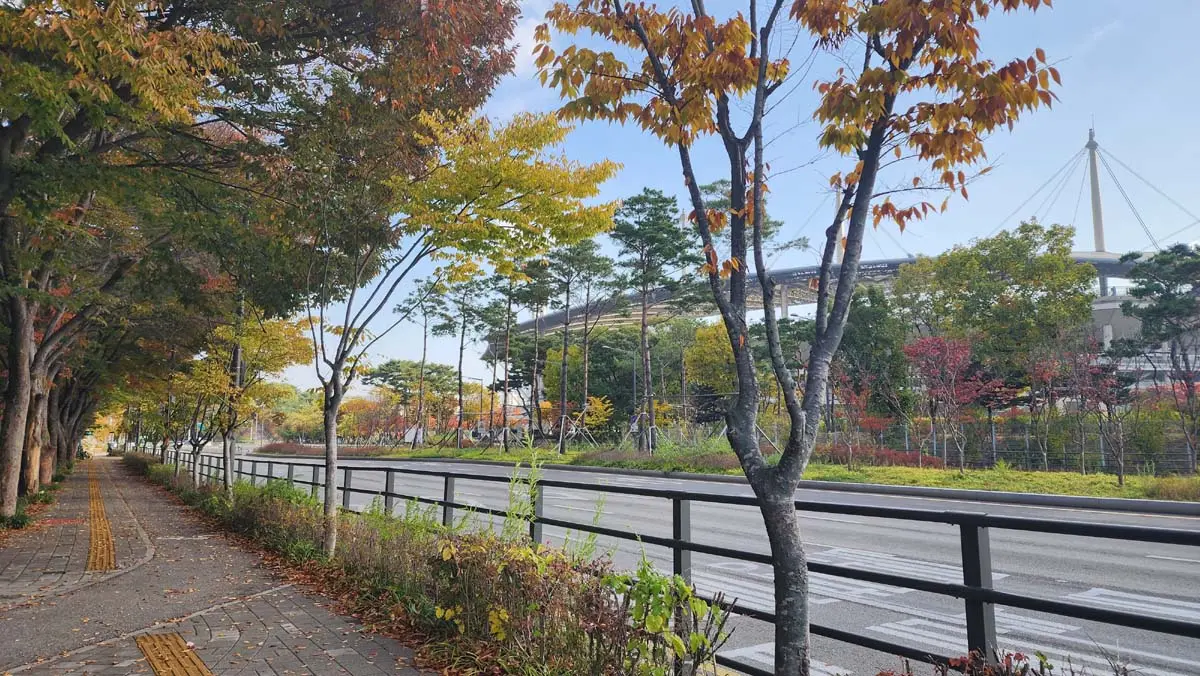
Over twenty years have passed since I first made Eunpyeong-gu my home. Boarding Bus No. 571 at the stop right outside my neighborhood, I got off at the World Cup Stadium station. Along the walk to the park entrance, the street trees had already turned brilliant shades of yellow and crimson. Whenever a gust of breeze swept through, a few dry leaves drifted down onto the sidewalk. Though these were familiar Seoul streets, the quiet shift of the seasons always invites a slower pace.
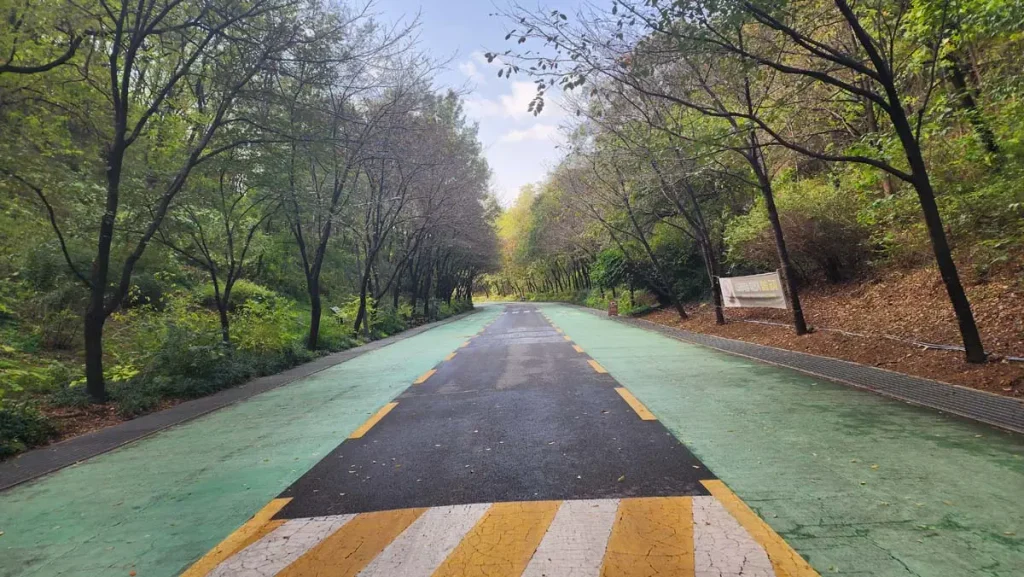
Arriving at the park entrance, I boarded the Maengkkongi Electric Tram heading up to the summit. Named after the narrow-mouthed toad (Kaloula borealis), an endangered species native to Korea, the tram symbolizes the ecological restoration of World Cup Park. The shuttle climbed steadily along the gentle slope. Alongside on the paved path, pedestrians strolled upward—no one was in a rush. People were simply taking in the autumn woods, ascending the hill at their own unhurried rhythm.
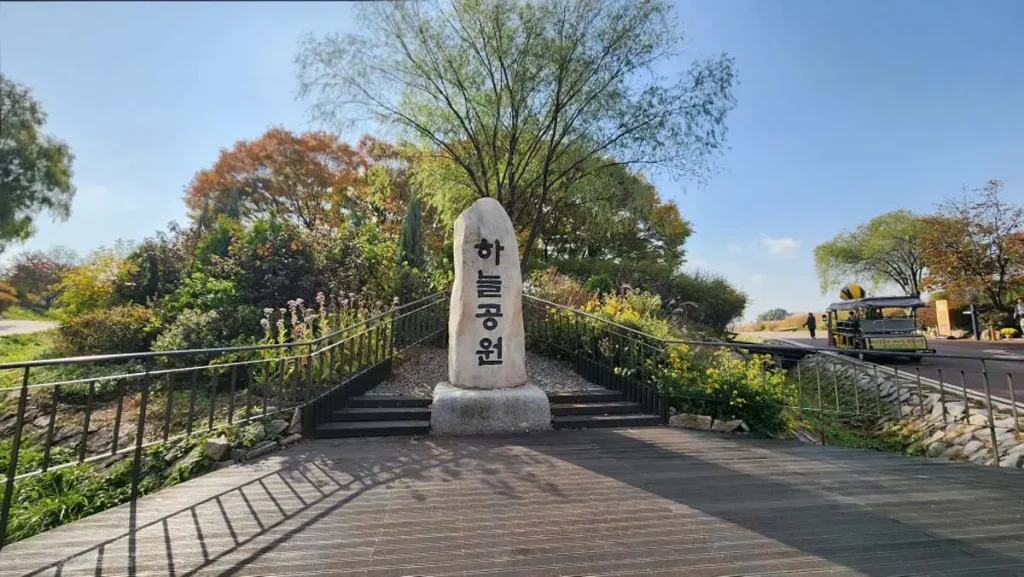
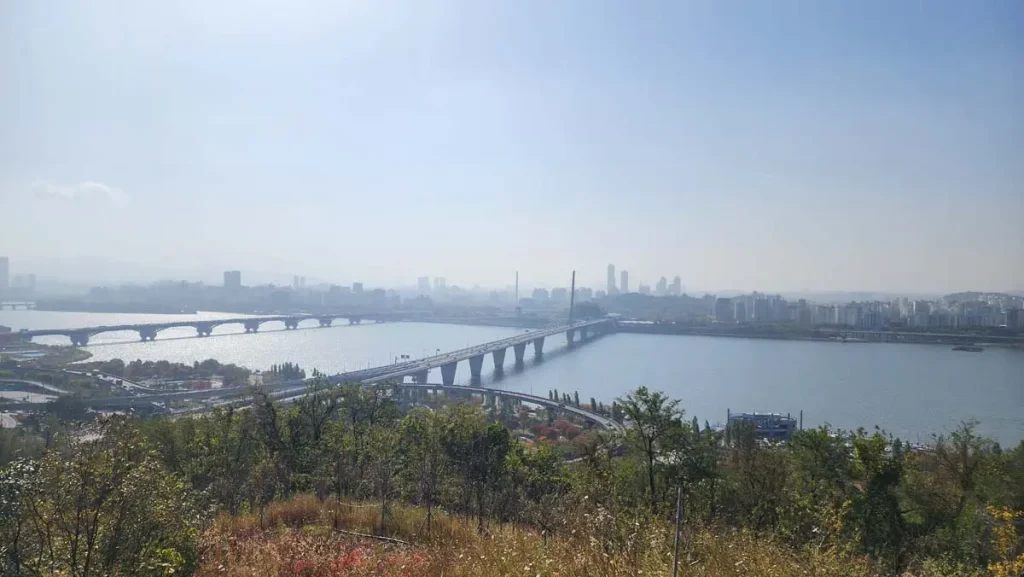
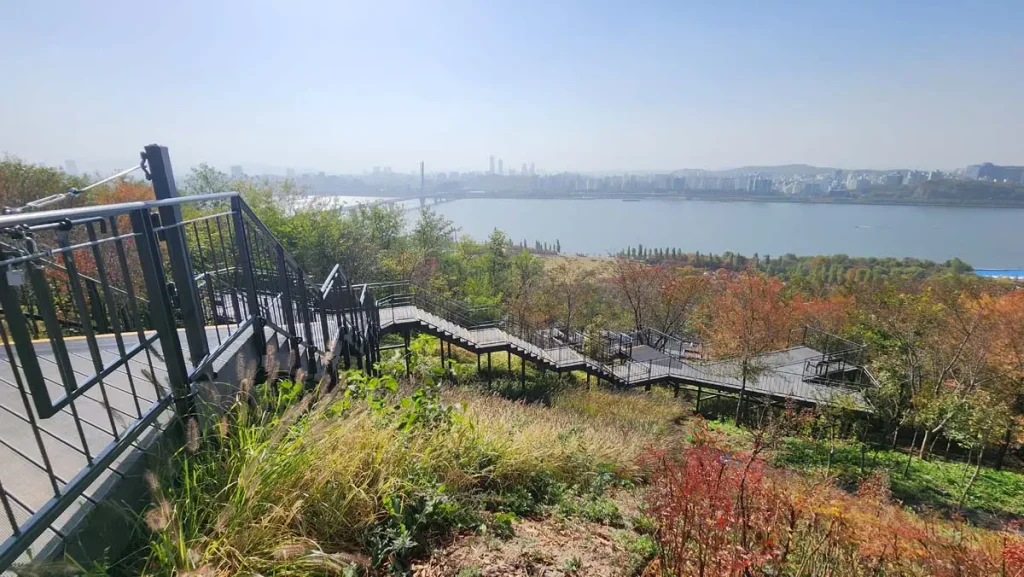
Stepping off the tram, I stood before the stone monument marking Haneul Park. Catching my breath and turning around, the Han River stretched out in a sweeping panorama below. Beyond Seongsan Bridge rose the skyline of Yeouido, while the river’s surface shimmered brightly in the autumn sunlight.
Even though it was the familiar skyline of Seoul I had seen countless times, viewing it from higher ground gave it a different resonance. Suddenly, I found myself wondering how people of centuries past viewed this very riverside—before highways, apartment towers, bridges, and skyscrapers reshaped the horizon.
Nanjido (蘭芝島): The Ancient Han River Island of Orchids and Gromwell
The hill where Haneul Park sits today was originally a low-lying river island along the Han River known as Nanjido (蘭芝島).
The name Nanjido translates to “Island of Orchids and Gromwell.” Here, jicho (gromwell)—often mistaken for reishi mushrooms due to identical Sino-Korean characters—refers to a wild perennial herb whose roots yielded prized purple dye. Historical records such as the Annals of the Joseon Dynasty note that gromwell roots were actively harvested to dye textiles during the Joseon era. Looking at the elevated park today, it takes imagination to picture, yet this ground was once a lush river island blanketed in wildflowers and tall reeds.
Historical geography notes offer several older names associated with the waters around Nanjido. Certain historical map commentaries link this area to Jungchodo (中草島), meaning “Island Thick with Grass,” while other accounts mention Orido (鴨島, “Duck Island”), named after the flocks of wild ducks that gathered along its banks.
Of course, determining precisely which era and geographical boundary each name denoted requires careful historical cross-referencing. For now, it is enough to remember them as evocative traces of a landscape that continually shifted alongside the currents of the Han River.
In those days, Nanjido was an untamed river sanctuary where reeds and silver grass swayed and migratory birds paused on seasonal journeys. As the river carried silt and sand downstream and carved new channels, the island’s contours subtly evolved—long before curated parks or towering landfills existed.
Views of the Old Han River from Mangwonjeong Pavilion and Yanghwanaru Ferry
Not far from this island along the western stretch of the Han River stood Yanghwanaru Ferry and Mangwonjeong Pavilion (望遠亭). Situated close to the capital walls of Hanyang (historic Seoul), this riverside corridor bustled with ferries, travelers, and scholars drawn to the river’s serene vistas.
Mangwonjeong Pavilion carries a notable chapter of royal history. Originally built in 1424 by Grand Prince Hyoryeong, elder brother of King Sejong, it was first named Huiujeong (喜雨亭, “Pavilion of Joyful Rain”).
According to the Annals of King Sejong, when King Sejong visited the western suburbs and ascended this pavilion in 1425 during a severe drought, welcome rain began to fall. Overjoyed for his farmers, the king bestowed the name Huiujeong upon the structure. Later, in 1484, Grand Prince Wolsan, elder brother of King Seongjong, renovated the pavilion and renamed it Mangwonjeong—meaning “Pavilion for Gazing Afar.”
Mangwonjeong was far more than a scenic retreat for poetic contemplation. Kings used it to inspect naval drills and military exercises, and the court hosted banquets here for visiting foreign envoys. It stood simultaneously as an appreciation point for the Han River’s natural beauty and an active stage for statecraft, diplomacy, and defense.
Grand Prince Wolsan even immortalized the surrounding landscape in verse. His poem, Yanghwadapseol (“Treading Snow at Yanghwa”), celebrates the winter beauty of the snow-covered river plains. I pictured figures standing along these wintry banks centuries ago, composing poetry as they watched the water flow—the very same river flowing quietly before my eyes today.
Naturally, surviving written records alone cannot fully reconstruct every detail of Nanjido as viewed from Mangwonjeong centuries ago; hundreds of years separate us from that era. Yet simply reflecting upon a world where people and riverine nature coexisted transforms the experience of walking here.
Nor was historic Nanjido solely a backdrop for aristocratic leisure. Its wetlands, grasses, and reeds were woven deeply into everyday rural life. In an agrarian society, riverside reeds provided essential materials for weaving mats, roofing, and fuel, while the floodplains served both people and livestock across changing seasons. Rather than an isolated wilderness, Nanjido was intimately tied to the daily livelihoods of people living along the Han River.
1978 to 1993: The Land That Absorbed Seoul’s Waste
Nanjido’s destiny changed dramatically in the late twentieth century.
In March 1978, the Seoul Metropolitan Government officially designated Nanjido as the city’s primary municipal landfill. It was an era of explosive population growth and rapid urban expansion. Day after day, household garbage, spent coal briquette ashes, and industrial refuse began piling onto the island.
Landfilling operations continued for roughly fifteen years until March 1993. What had once been a flat river island transformed into an immense dumping ground. As waste accumulated relentlessly, two massive mountains of trash rose from the riverbank, reaching roughly 98 meters (over 320 feet) above sea level.
A name that once evoked wild orchids and purple gromwell became synonymous with refuse and foul odors. It became the land forced to absorb everything a booming metropolis discarded—a stark monument to the hidden environmental cost behind rapid urban convenience.
The transformation of Nanjido was more than the altered fate of a single island; it stood as a sobering reflection of where unchecked urban consumption inevitably leads.
Silver Grass and Ecological Restoration Atop a Mountain of Trash
Stepping deeper into the park, the horizon suddenly opened wide.
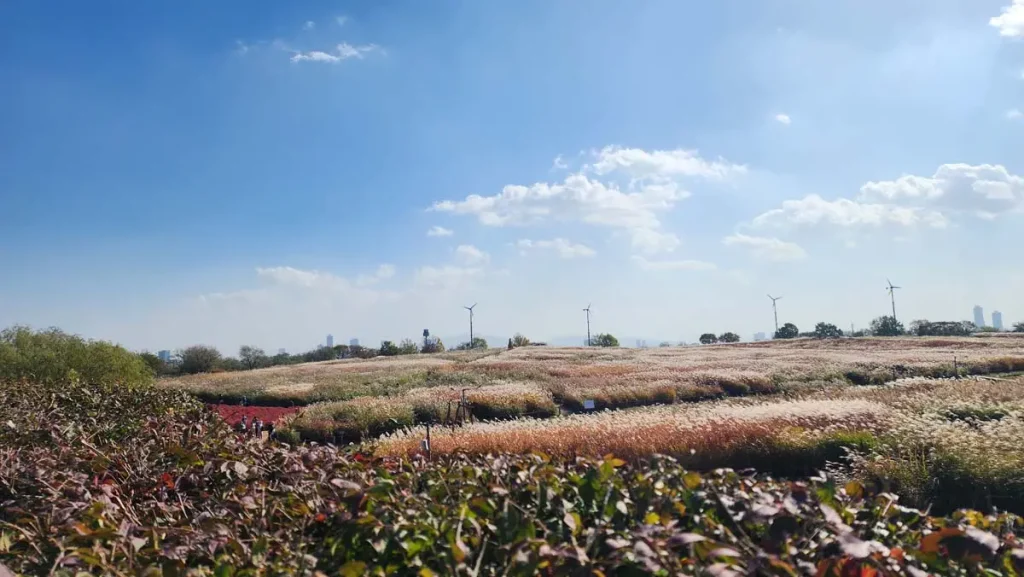
Fields of silver grass (eulalia) towering well above human height blanketed the plateau. Whenever a breeze swept across the ridge, thousands of feathery plumes leaned together in unison before rising back upright. Stepping closer, I heard the soft, dry rustle of slender leaves brushing against one another as visitors strolled leisurely along narrow dirt paths winding through the grass.
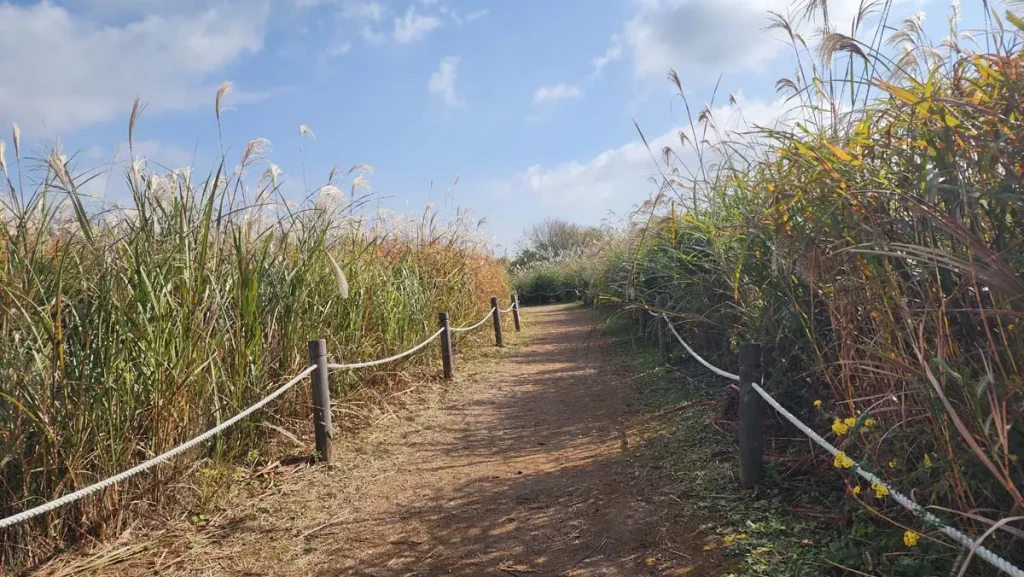
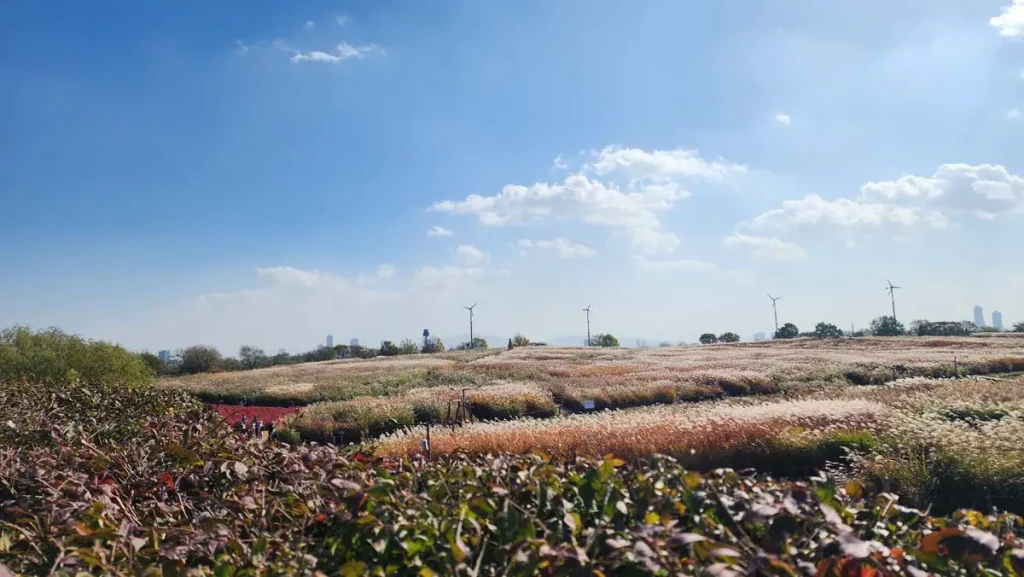
In one section stood clusters of vibrant crimson kochia (summer cypress). As autumn deepened, their foliage shifted from summer green to rich shades of scarlet and magenta, creating a striking contrast against the shimmering silver grass.
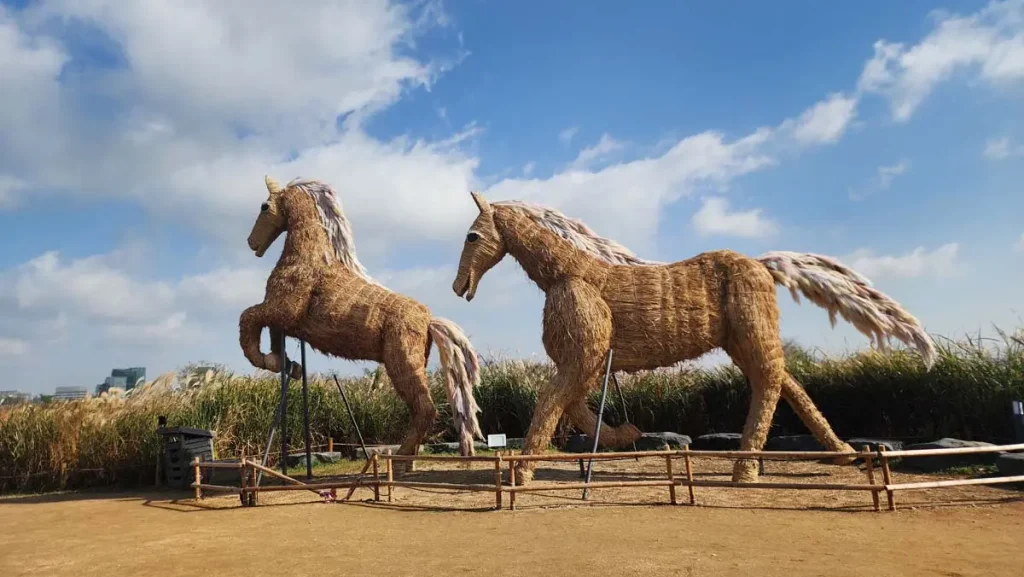
Nearby in the meadow stood two large horse sculptures woven from rice straw. Though crafted from lightweight natural materials, their impressive scale caught the eye from afar, standing with lively grace against the crisp blue sky.
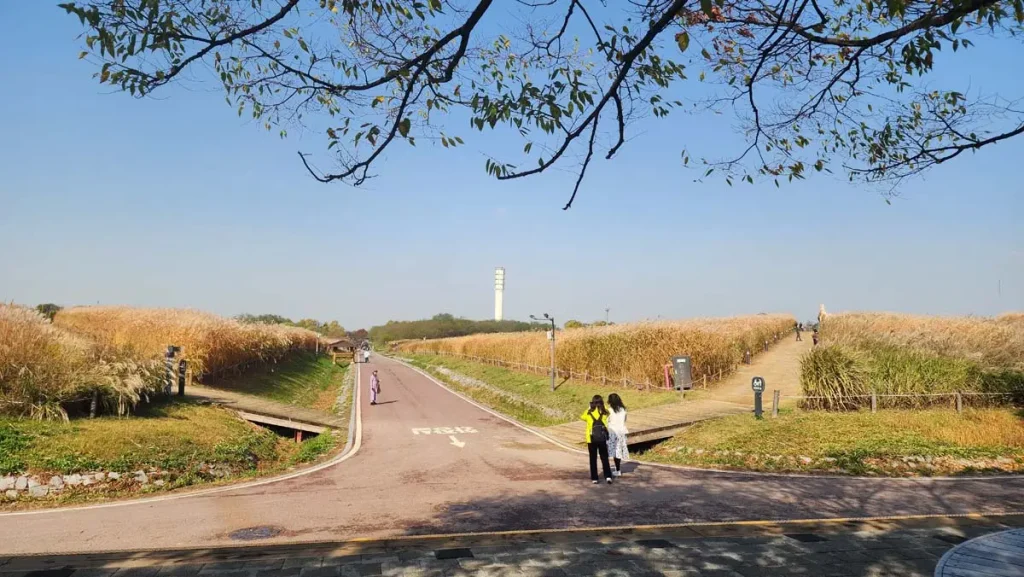
Beyond the silver grass fields, tall wind turbines came into view, their white blades turning slowly in the autumn wind over undulating waves of grass. Looking at this serene landscape alone, it is hard to fathom that just decades ago, this very ground was a monumental garbage dump.
World Cup Park and the Record of Ecological Recovery
Walking along the trails, I reflected on the painstaking engineering and care required to reclaim this land as a public park.
After landfill operations closed in 1993, rather than excavating and relocating millions of tons of waste elsewhere, Seoul opted for an ambitious stabilization and ecological reclamation project. Workers capped the waste mounds with thick layers of clean topsoil, installed leachate treatment systems to prevent groundwater contamination, and built wells to capture methane landfill gas for clean district energy.
While it might appear on the surface like simply covering dirt with plants, transforming a massive landfill into a safe public park was a complex environmental undertaking requiring continuous management of subsurface gases and runoff.
Opened in May 2002 ahead of the FIFA World Cup, World Cup Park transformed the twin waste mounds into Noeul Park (Sunset Park) and Haneul Park (Sky Park), flanked by Peace Park and Nanjicheon Park below. Land that once received Seoul’s refuse had been reborn as a sanctuary where citizens walk and rest.
Yet nature did not heal overnight upon the park’s opening. Sustained ecological stewardship, careful planting, and habitat monitoring gradually reshaped the ecosystem over many years.
According to a 2016 ecological monitoring report published by the Seoul Metropolitan Government covering the entire World Cup Park complex, recorded flora and fauna species surged from 559 in 2000 (prior to park construction) to 1,557 species. Today, endangered narrow-mouthed toads inhabit the wetlands of Haneul and Noeul Parks, while common kestrels and diverse bird species once again nest and hunt above the grasslands.
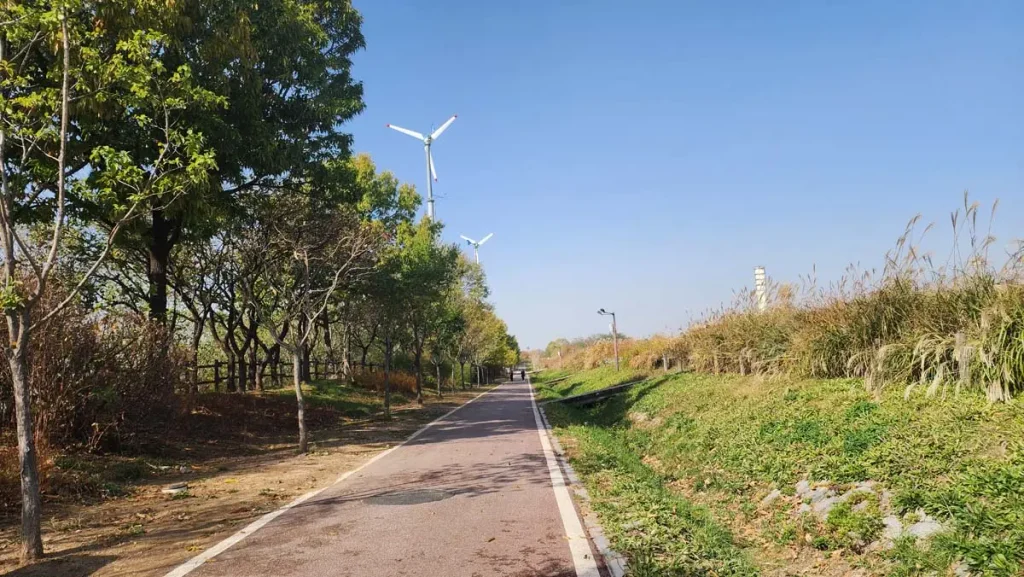
Even the signature silver grass of Haneul Park did not sprout here entirely on its own; it was intentionally planted during ecological restoration to stabilize the soil and prevent erosion. Through years of tending, those planted grasses became the defining emblem of the park.
Knowing that history made the swaying plumes before me feel even more poignant. This scenery was not merely nature reclaiming itself unaided—it was a living collaboration between human hands tending damaged earth and nature’s quiet resilience.
Three Layered Eras of Nanjido Resting on a Single Hill
I continued strolling through the silver grass trails. Whenever the wind stirred, the stalks bent gracefully in waves, prompting walkers to pause for photographs. I, too, stopped several times simply to take in the surroundings.
Walking this ridge brings three distinct eras of history naturally into focus:
- The First Era (Island of Nature): A time when orchids, gromwell, and river reeds flourished along the Han River, and people lived alongside the water while scholars gazed from Mangwonjeong Pavilion to compose poetry.
- The Second Era (The Shadow of Urban Growth): From 1978 to 1993, when rapid industrialization turned Nanjido into Seoul’s landfill—bearing the heavy environmental burden behind modern urban convenience.
- The Third Era (Ecological Restoration and Renewal): Following landfill closure, the stabilization of the earth and replanting of native flora that gave birth to World Cup Park in 2002—the very sanctuary we walk through today.
Three separate chapters of time rest layered atop this single hill. Looking solely at the silver grass on the surface does not immediately reveal what lies beneath—which is why the beauty of this place cannot be captured merely by calling it picturesque.
Of course, turning a landfill into a park does not erase every underlying challenge. Subsurface waste and landfill gases still require vigilant, ongoing monitoring, and no reclaimed site ever returns completely to its untouched primordial state.
Even so, walking here leaves one unmistakable conviction: healing the nature that humanity has wounded also remains humanity’s responsibility.
Reflecting on the history resting beneath my feet made the peaceful autumn afternoon feel all the more precious—the rustling silver grass, the distant Han River, and unhurried visitors strolling between them. None of this quiet beauty would exist today without decades of patient effort and care.
Thus concluded my November afternoon at Haneul Park. What began as a simple walk to admire autumn silver grass became a deeper reflection on the three overlapping eras held within this hill.
As far as historical records speak, I walk with history; where written records fall silent, I step forward acknowledging imagination. What I brought home from Nanjido today was far more than photographs of silver grass—it was a deeper awareness of a place’s resilience and a renewed lens through which to see the city’s landscape.
📍 Haneul Park Visitor Guide (Directions, Electric Tram Fares & Facilities)
For first-time visitors planning a trip to Haneul Park, here is a practical summary of public transit access, Maengkkongi Electric Tram fares, and on-site amenities.
1. How to Get to Haneul Park (Public Transit)
- Address: 95 Haneulgongwon-ro, Mapo-gu, Seoul (Sangam-dong)
- By Subway: Take Seoul Subway Line 6 to World Cup Stadium Station (Exit 1) and follow signs toward World Cup Stadium Intersection and the Haneul Park pedestrian overpass. The walk from Exit 1 to the Maengkkongi Electric Tram ticket booth (near Nanjicheon Park parking lot) is roughly 800 meters (about 10–15 minutes on foot).
- By City Bus: Get off at the World Cup Park Entrance / Oil Tank Culture Park Entrance stop and walk directly toward the park information center and electric tram ticket booth.
2. Ways to Reach the Summit of Haneul Park
- Maengkkongi Electric Tram: Purchase a ticket at the Nanjicheon Park booth for a quick, comfortable ride to the summit—ideal for seniors, families with young children, or anyone conserving energy.
- Paved Hilltop Trail (Walking): Follow the gentle paved road alongside the tram route. Recommended if you prefer avoiding steep stairs while enjoying a quiet forest walk.
- Haneul Stairway (291 Steps): A direct wooden staircase climbing straight up the hillside to the observatory. Offers scenic views along the climb, though moderately steep.
3. Maengkkongi Electric Tram Fares & Operating Information
| Category | One-Way Fare | Round-Trip Fare |
| Adults | 2,000 KRW | 3,000 KRW |
| Children (Ages 4–12) | 1,500 KRW | 2,200 KRW |
| Seniors (65+) & Visitors with Disabilities | 1,500 KRW | 2,200 KRW |
- Route: Nanjicheon Park Ticket Booth ↔ Haneul Park Summit
- Inquiries: +82-2-300-5501
- Visitor Tip: Operating hours adjust seasonally with sunset times. During peak autumn foliage and silver grass season (October–November), ticket queues can grow long, so plan for extra waiting time.
4. Park Amenities (Concessions, Convenience Stores & Restrooms)
- Concessions & Convenience Store: A snack stand and convenience store operate near the summit, offering hot cup noodles, beverages, and light refreshments.
- Restrooms: Public restrooms are conveniently located at key intervals along the park’s main walking trails.