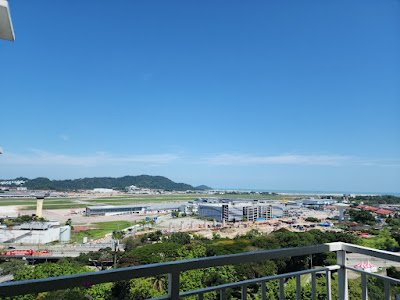
Outside the living room window where the Historical Flâneur sits, July in Penang softly unfolds. Low-hanging clouds tint the sky in silver-grey, and a damp, warm breeze drifts through the open window into the quiet room. Holding a warm cup of coffee with both hands, I gaze out the window, quietly welcoming the arrival of my life’s second act.
Before me stretches the runway of Penang International Airport. An aircraft begins its slow taxi, and beyond the tarmac, a calm sea draws a quiet horizon. Between the airport and the water runs a coastal road, where cars stream past without pause.
A path through the sky, a path across the sea, and a path along the earth.
Three different paths converge within a single scene.
My wife gazes out, tracking the plane about to take off. For most, the gaze naturally gravitates toward the kinetic rush of the airport or the lively urban backdrop. But this morning, my eyes linger long upon the sea.
The First Path a Boy Ever Knew
To me, the sea was never just scenic scenery; it was the very first path I ever encountered in this world.
Memory gently takes me back to the early 1970s, to a tiny island village on Sinui Island (Sinui-do) in South Jeolla Province, Korea—a place where electricity had not yet arrived. When the sun dipped below the horizon, pitch-black darkness enveloped the village, and only the soft glow of a single kerosene lamp lit our room. Walking at night meant holding a small reddish lantern, finding our footing along unpaved dirt trails to reach home.
Back then, the world felt very small to a young boy.
The only means of transportation were two legs, and the only road leading out of the island was the sea.
I would often sit upon a broad rock on the hill before our house. There, I would watch the ferry pass by a few times a day, parting the white water as it steamed toward the mainland. In its wake, a long aquatic trail drifted across the surface.
Looking back, that was far more than an ordinary shipping route.
It was the very first map of the future, quietly etched into the heart of a boy who would one day wander the world as a Historical Flâneur.
That water path embodied a quiet longing for the wider world, a yearning and hope for the lives and people I had yet to meet.
Learning as a Lifelong Compass
Eventually, following that wake, I left the island.
The boy who once harbored quiet dreams under a kerosene lamp grew up to walk countless roads built by a fast-evolving era.
The past six decades have witnessed some of the most dramatic transformations in human history. From kerosene lamps to LED lights, handwritten letters to smartphones, and slow passenger ferries to international flights—these seismic shifts all took place within a single lifetime.
Yet I was never someone who merely watched those changes from afar.
Learning, working, stumbling, and rising again, I journeyed through that era alongside others. The feet that once tread muddy tidal paths learned to stride across paved asphalt, and the boy who once looked out from an isolated shore crossed international borders aboard jetliners.
Throughout it all, one timeless phrase stayed anchored in my heart:
“Yu Jae Mi, Bul Hak Bul Go (有才未 不學不高).”
It carries an enduring truth: no matter how gifted one may be by birth, without continuous learning, one can never attain true depth or reach higher ground.
I treated this ancient maxim not merely as a proverb, but as a practical compass for living. Whenever the times changed, I never feared learning anew; rather than settling into comfortable familiarity, I chose to walk forward with the humble mind of a student.
In hindsight, my journey may be far from grand societal achievements or conventional success. Yet if I was able to cross those long decades with quiet resolve, it was not owed to exceptional talent, but to those humble, steady steps of never letting go of the desire to learn.
Then one day, quite suddenly, I stood before the milestone of retirement.
At first, it felt like an ending.
Looking back today, however, it was never a conclusion. It was a fresh beginning—a moment to finally step out at my own pace, reading the world through the quiet lens of a Historical Flâneur.
The Perspective of a Historical Flâneur: Reading the Breath of Time
During these contemplative days in Penang, I found myself looking back across the arc of my life.
And there, I discovered an identity.
I decided to call myself a Historical Flâneur—a contemplative stroller who walks through history.
I have always preferred quiet alleyways over formal museums.
Rather than polished artifacts behind glass, I find myself observing the worn wooden stools in traditional wet markets. Rather than famous tourist landmarks, I linger at everyday street corners where ordinary people pass by each day.
For history is not something confined within glass display cases.
History lives today in the steam and savory aromas rising from neighborhood food stalls; it endures in the touch of forgotten hands that laid aged clay bricks; and it breathes quietly in the steady footsteps of ordinary individuals navigating their daily lives far from home.
Even when looking out at the ancient sea lanes of the Age of Discovery, I do not think solely of glorious voyages and celebrated explorers. I remember the quiet fears of nameless sailors who ventured into the unknown, and the tears of indigenous peoples whose homes were forever altered by those very routes.
What was a path of triumph for some was, for others, an irreversible path of loss.
To reflect on history, I believe, is not to read solely the chronicles of the victors, but to listen attentively to the quiet breath of every ordinary soul who lived through those times.
In truth, I have never accomplished monumental feats, nor do I claim remarkable worldly success.
I am simply one traveler among the multitude who weathered a turbulent, fast-changing era.
Yet, living an ordinary life does not mean that life becomes an ordinary footnote in history.
My days have flowed alongside the current of our times, just as the quiet side streets and morning markets I meet today hold deep layers of time left behind by countless nameless lives.
That is why I choose to look closely at the breath of everyday people rather than the grand footprints of historical figures.
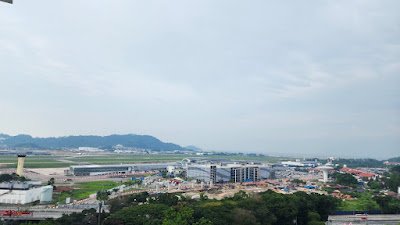
Once more, I look out the window.
An airplane climbs into the sky, automobiles trace the curve of the highway, and the open sea quietly cradles its timeless waterways.
A quiet realization settles in.
The airport is a road; the sea is a road; the highway is a road.
And human life itself is one long, unhurried journey.
To the boy, the sea taught yearning.
To the young man, the road taught perseverance.
Now, stepping into the second act of life, the road teaches me contemplation.
I no longer require elaborate gear for my travels.
The simple walking stick in my hand is all I need.
It serves as a quiet support for my legs, while remaining a faithful companion that helps this Historical Flâneur trace the delicate threads connecting yesterday and today.
With this single stick as my companion, I will continue to wander through city alleyways, walk beneath roadside trees, and look out over coastal horizons.
There, I will meet the lives of ordinary people, listen to their gentle breathing, and slowly read the unseen textures of passing time.
I am no longer in a hurry.
For I have learned that looking deeply and walking slowly is far richer than arriving quickly.
I am not an academic scholar of history.
I am simply someone who walks the very roads where history still lives and breathes.
Today, with a walking stick in hand, I stroll across the yesterday and today of this city.
And holding the stories of the people I meet along the way close to my heart, I will write them down line by line—through the gentle gaze of a Historical Flâneur.
July 15, 2026, in Penang, Malaysia
The day I concluded my career as an office worker and took my first step as a Historical Flâneur.
I do not search for the history of celebrated figures.
I encounter history within the everyday lives of nameless people.I choose alleyways over museums,
remember human breath over silent relics,
and walk through a city’s yesterday and today with a simple stick in hand.I am in no hurry.
For the path is not a mere destination—it is a journey toward understanding humanity.